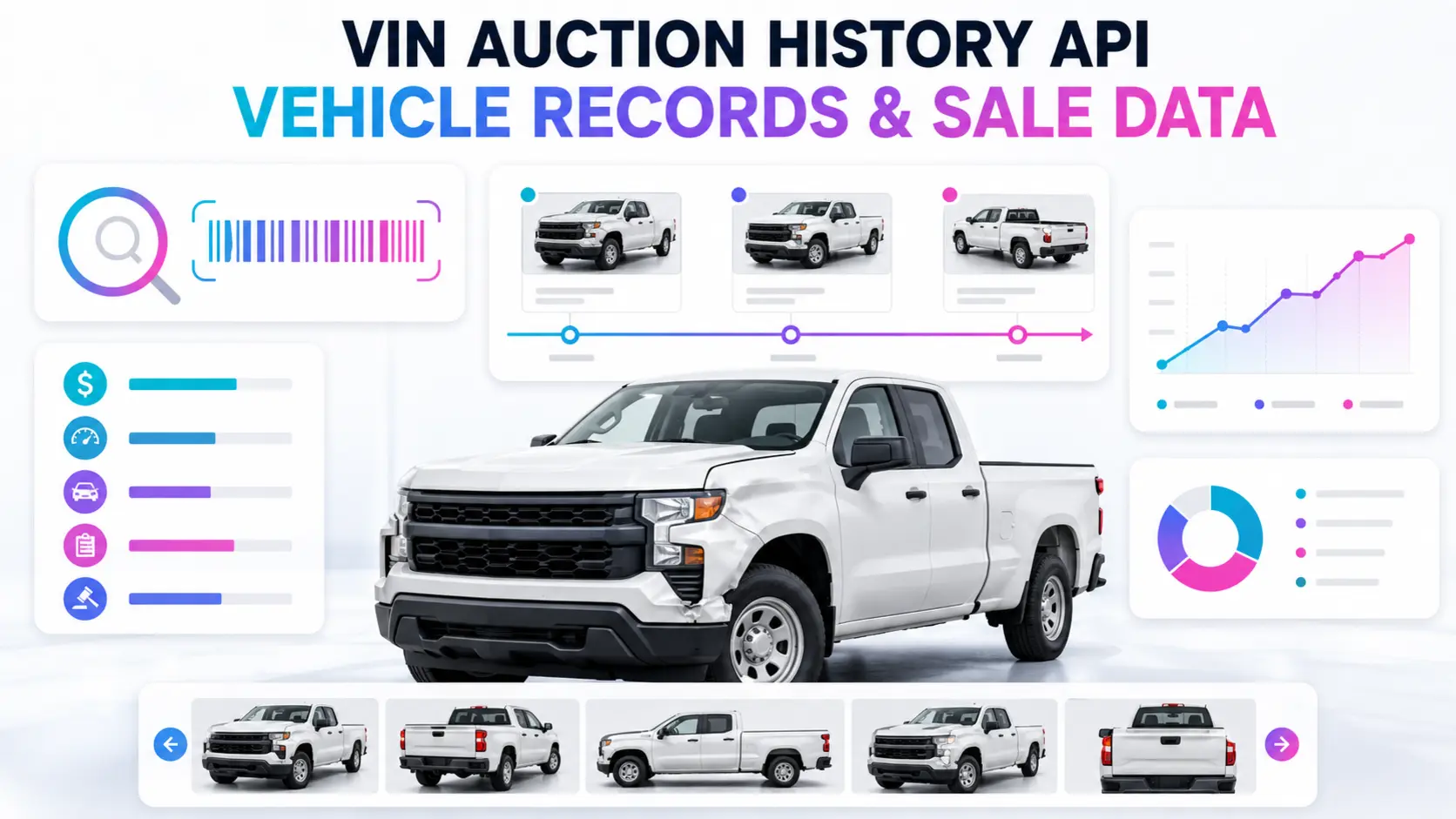
A VIN Auction History API retrieves available vehicle auction records connected to a Vehicle Identification Number. Applications can use it to display previous Copart and IAAI listings, auction dates, recorded prices, sale status and other lot information when historical data exists.
The Apibara.tech Vehicle Auction Data API provides structured JSON access to supported current and historical Copart and IAAI records. Developers can search for a vehicle, retrieve its normalized details and request available auction history through a dedicated endpoint instead of maintaining separate auction parsers and historical databases.
What Is a VIN Auction History API?
A VIN Auction History API is a developer interface for finding historical auction records associated with a vehicle identifier. It converts available past listings and sale events into a structured response that can be used by VIN lookup websites, automotive marketplaces, dealer tools, import platforms, valuation products and internal research systems.
The VIN is usually the most stable identifier because the same vehicle can receive different lot numbers when it is relisted. However, VINs can be missing, partially masked or incorrectly entered in source data. For that reason, the Apibara.tech endpoint also accepts a supported lot number or public vehicle identifier through the {slugVin} path parameter.
VIN Auction History Is Not a Complete Vehicle History Report
Auction history and full vehicle history are related but different products. Auction records can show how a vehicle appeared in supported Copart or IAAI data, including available photos, damage descriptions, odometer readings, prices and sale events. They do not automatically provide every ownership change, accident, repair, insurance claim, registration event, service visit, theft record, recall or government title event.
| VIN auction history may provide | It should not automatically claim |
|---|---|
| Previous supported Copart or IAAI records | Complete history across every auction and country |
| Auction or listing dates when retained | Every ownership or registration date |
| Recorded bid, sale or price fields when available | Guaranteed final transaction value |
| Source damage and condition information | Complete accident or repair history |
| Photos and media attached to supported records | Current mechanical condition |
| Sale or lot status captured in the data | Legal title status in every jurisdiction |
Use precise labels such as “auction history,” “previous auction records” and “available sale data.” Avoid statements such as “clean history” simply because the API returns no previous record.
What Data Can an Auction History Record Contain?
Field availability varies by source, vehicle and retained record. A useful history interface should be prepared to display:
- Vehicle identity: VIN, year, make, model and normalized title.
- Auction source: Copart or IAAI and the associated lot number.
- Auction date: the recorded listing, auction or sale timestamp when available.
- Price information: current bid, Buy Now, recorded sale price or another clearly labelled price field.
- Sale status: open, live, ended, sold, removed or another supported source/normalized state.
- Condition: primary or secondary damage, run condition and key availability when present.
- Odometer: recorded mileage and unit for that event.
- Location: auction facility, branch, city or state when available.
- Media: vehicle photos, video or 360-degree media retained with the record.
- Sale document: source document name and normalized attributes when supported.
Do not merge different price types into one generic “price.” A current bid, Buy Now amount, estimated retail value and final sale price describe different things and must remain separately labelled.
How the VIN Auction History Endpoint Works
The dedicated endpoint is:
GET /api/v1/vehicle-auction/vehicles/{slugVin}/historyThe path parameter can contain a supported VIN, lot number or public vehicle identifier. History results use cursor pagination, with a maximum of 20 records per request. Applications should pass the returned meta.next_cursor value back through the cursor parameter rather than building cursor values manually.
curl -G "https://apibara.tech/api/v1/vehicle-auction/vehicles/WBA4J7C55KBM75906/history" \
  -H "Accept: application/json" \
  -H "X-API-Key: YOUR_API_KEY" \
  --data-urlencode "per_page=20"
Keep the API key on your protected backend. Do not expose it in frontend JavaScript, mobile application bundles, public repositories, screenshots or analytics logs.
Recommended VIN Lookup Flow
- Validate the input. Normalize casing and whitespace, but do not silently replace uncertain VIN characters.
- Resolve the vehicle. Request
GET /vehicles/{slugVin}to confirm the supported identity and show current normalized details. - Request auction history. Call
GET /vehicles/{slugVin}/historyfrom the backend. - Sort and group events. Build a chronological timeline without treating duplicated collection snapshots as separate sales.
- Label every value. Preserve the source, date, price type, currency, odometer unit and captured status.
- Explain limitations. State when fields or earlier records may be unavailable.
- Offer relevant next steps. Show the current vehicle record, related vehicles or available shipping data where useful.
How to Build a Useful Auction History Timeline
A raw JSON array is useful to developers, but buyers need a clear sequence of events. Each timeline card should identify the source and lot, event date, captured vehicle condition, odometer, location, price type and status. When images exist, use one representative thumbnail and let the visitor open the full event.
Never infer an event that the data does not confirm. For example, an “ended” auction is not automatically a completed sale, and a recorded current bid is not automatically the final purchase price. If the same vehicle appears more than once, explain whether it is a relisting, a new lot record or another retained snapshot.
| Timeline field | Display recommendation |
|---|---|
| Event date | Use the source timestamp and show its timezone where relevant. |
| Platform and lot | Keep the source identity visible for every event. |
| Price | Label bid, Buy Now and sold price separately. |
| Odometer | Keep the captured value and original unit; converted units are estimates. |
| Damage | Present source descriptions without upgrading them to an independent inspection. |
| Status | Use the stored status and avoid assuming that “ended” means “sold.” |
Applications for VIN Auction Records
VIN lookup websites
Add available auction events, photos and prices to a VIN research page. Keep auction data in its own clearly named section instead of presenting it as a complete vehicle-history certificate.
Automotive marketplaces
Help a buyer understand whether a vehicle appeared in supported US auctions before. Historical event pages can also strengthen internal linking and provide useful context after an active lot ends.
Dealers and vehicle sourcing teams
Compare previous auction condition, odometer and price information before selecting or bidding on inventory. Historical records should support—not replace—inspection and due diligence.
Car import and export platforms
Connect a customer’s VIN request with available auction photos, sale data, source location and logistics workflows. Preserve the original USD values alongside any estimated local-currency conversion.
Pricing and automotive analytics
Use properly classified historical prices as evidence for comparable-vehicle analysis. Separate observed bids from final sale prices, and account for damage, odometer, location and sale date before comparing records.
Fraud and listing review tools
Flag meaningful differences between a historical auction record and a current seller listing—for example, odometer or damage-description changes—without automatically accusing a seller of fraud. Differences require human review and additional evidence.
Data Coverage and Missing History
History availability depends on the VIN, lot, source platform and records retained by Apibara.tech. Some vehicles have several supported events; others may have one or none. Photos, prices, sale results, odometer, seller and title fields can also be incomplete.
An empty response means that no matching history was returned under the current lookup and available coverage. It does not prove that the vehicle has never been sold, damaged, registered or listed elsewhere. Display a neutral message such as: “No supported Copart or IAAI auction history was found for this identifier.”
Handling Relisted Vehicles and Duplicate Records
A vehicle can appear under different lot numbers or be collected more than once as its listing changes. Do not deduplicate solely by VIN because that could remove genuine relisting events. Instead, compare a combination of platform, lot number, auction date, captured status and relevant timestamps.
- Keep distinct auction events when the lot number or sale cycle changes.
- Merge or hide technical duplicates that represent the same captured event.
- Retain the earliest and latest known values when analysing field changes.
- Record when your application first observed an event separately from the source auction date.
- Do not overwrite a known historical value with
nullwithout a documented merge rule.
SEO for VIN Auction History Pages
VIN pages can answer highly specific searches, but they must provide real value and protect sensitive or misleading information. Create an indexable page only when it contains a supported vehicle identity and useful visible content.
- Use one canonical URL for each resolved vehicle identity.
- Render core identity and auction-event content in the initial HTML.
- Create a descriptive title using year, make, model and VIN context without keyword stuffing.
- Show the last data update and explain auction-history limitations.
- Use
noindexfor empty, invalid, private or extremely thin lookup pages. - Do not publish infinite URLs created from arbitrary search strings.
- Keep ended vehicle pages when their historical records remain useful.
- Add structured data only for facts visibly supported on the page.
For AI search systems, use explicit statements: what the endpoint returns, which sources are supported, what identifier it accepts and what the history does not include. Clear limitations make the page more trustworthy than exaggerated “complete VIN history” claims.
Errors and Production Safeguards
- 400 or 422: validate the identifier and query parameters before retrying.
- 401: check the server-side API key; never request a key from a site visitor.
- 404: show that no supported vehicle or history record was resolved, not that the vehicle does not exist.
- 429: apply capped exponential backoff and monitor plan usage.
- 5xx or timeout: retry safe reads carefully and serve a timestamped cached result where appropriate.
- Nullable fields: display “Not provided” rather than inventing a value.
Common VIN History Integration Mistakes
- Describing auction history as a complete ownership or accident report.
- Claiming “no accidents” when no auction record is returned.
- Using lot number as the only permanent vehicle identity.
- Combining bid, Buy Now, retail estimate and sale price into one field.
- Assuming an ended auction always resulted in a sale.
- Dropping genuine relisting events during VIN deduplication.
- Displaying a missing price or odometer as zero.
- Publishing empty VIN search pages for Google to index.
- Exposing
X-API-Keyin browser code or public repositories.
Frequently Asked Questions
What is a VIN Auction History API?
It is an API that returns available historical auction records associated with a VIN or another supported vehicle identifier, including source, dates, prices and sale-status information when retained.
Can I retrieve both Copart and IAAI auction history?
Yes. Apibara.tech provides supported Copart and IAAI records through one normalized API integration while preserving the source platform for each event.
Does the API return previous auction prices?
History records may contain price fields when they were available and retained. Always distinguish current bid, Buy Now, estimated value and final sale price.
Does no result mean the vehicle has no auction history?
No. It means no matching history was returned within the current supported data and lookup. The vehicle may have records outside the available sources or coverage.
Is VIN auction history a complete vehicle history report?
No. It covers available auction records. It does not automatically include every owner, accident, repair, insurance, registration, theft, recall or government-title event.
Can the history endpoint accept a lot number?
Yes. The documented {slugVin} parameter can be a supported VIN, lot number or public vehicle identifier.
How is history pagination handled?
The endpoint uses cursor pagination with up to 20 history records per request. Pass the returned cursor rather than constructing one manually.
Can I use auction history for vehicle valuation?
Yes, as one input. Compare the same price type and consider date, condition, damage, odometer, location and vehicle specification before drawing a valuation conclusion.
Add VIN Auction Records to Your Product
Use Apibara.tech to retrieve normalized vehicle details and available Copart and IAAI auction history through one server-side JSON API.
Test a VIN or lot number, review the endpoint reference or read the documentation.
Related guides: how to get Copart lot details with an API, IAAI API for auction lot details and Vehicle Auction Data API use cases.