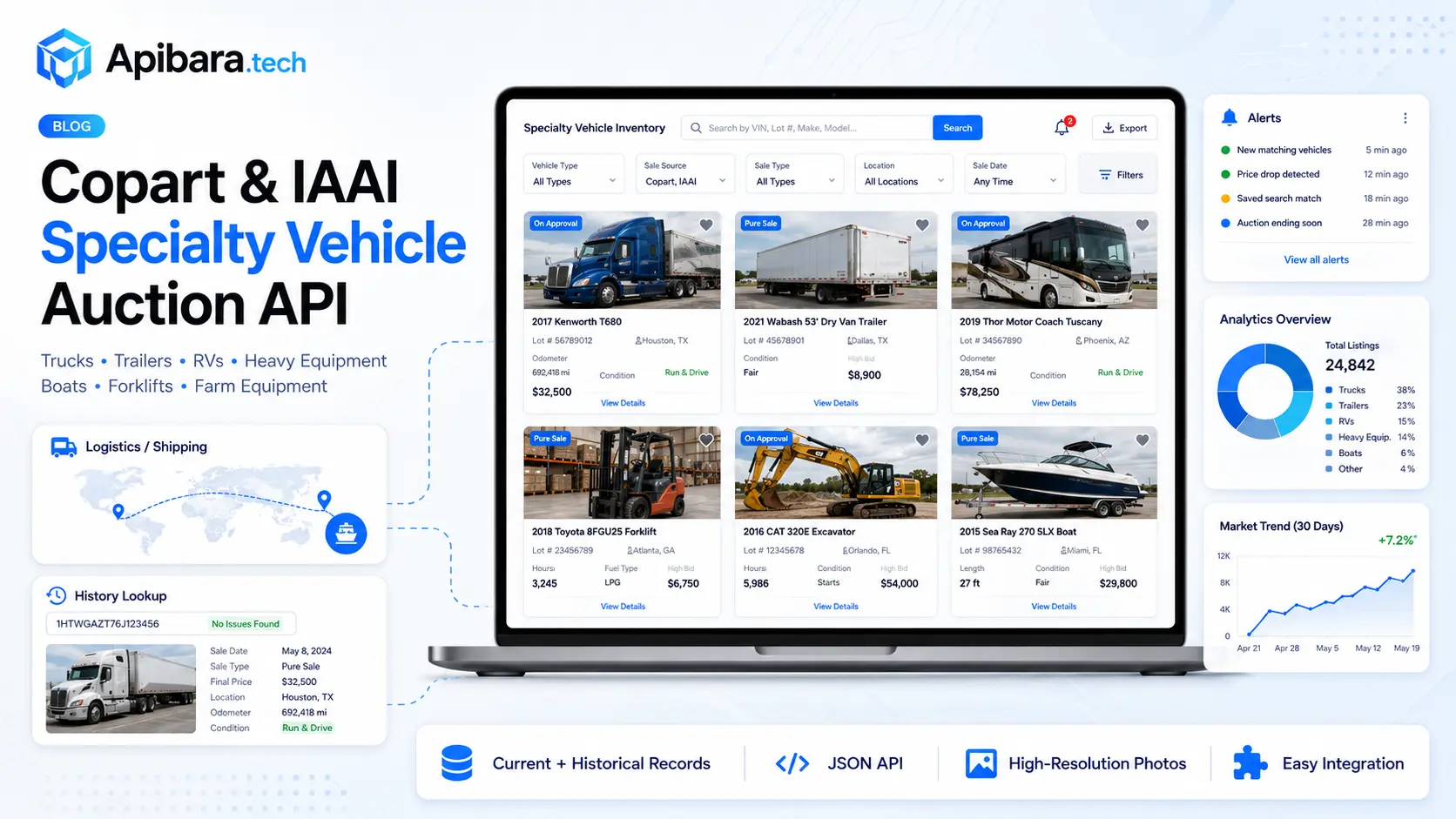
Copart & IAAI Specialty Vehicle Auction API for Trucks, Trailers, RVs & Heavy Equipment
Vehicle auction data is not limited to passenger cars.
Copart and IAA regularly list specialty inventory that includes heavy-duty and commercial trucks, trailers, semi-trailers, recreational vehicles, motorhomes, industrial equipment, construction machinery, agricultural equipment, boats and other non-standard vehicles.
Copart operates dedicated Specialty Vehicle Auctions for categories including heavy-duty trucks, trailers, semis, construction equipment, farm machinery and RVs, while IAA Specialty covers light, medium and heavy equipment including semis, trailers and RVs.
For developers, marketplaces, equipment dealers, exporters and data platforms, this inventory creates a different problem from ordinary vehicle search: collecting and normalizing multiple categories, auction sources, locations, photos, prices, status information and historical records into a consistent format.
The Apibara.tech Vehicle Auction Data API provides one structured API layer for supported Copart and IAAI auction records, including specialty inventory when available from the source.
Quick Answer
A specialty vehicle auction API lets an application search and process auction inventory beyond normal passenger cars.
With Apibara.tech, developers can use the same Vehicle Auction Data API used for regular automotive inventory to work with supported specialty categories such as:
- heavy-duty and commercial trucks;
- trailers and semi-trailers;
- RVs, motorhomes and travel trailers;
- industrial equipment and forklifts;
- construction equipment;
- agricultural and farm equipment;
- boats and other marine inventory;
- buses, emergency vehicles and other specialty auction inventory when present in the source data.
The API combines supported Copart and IAAI records behind one JSON interface and provides search, lot details, photos, prices, auction status, history, locations and other available fields without requiring a separate integration for every auction source.
Explore the Apibara Vehicle Auction Data API
Specialty Auction Data Goes Far Beyond Cars
Automotive auction platforms contain much more inventory than sedans, SUVs and pickup trucks.
Copart's specialty inventory includes categories such as heavy-duty trucks, trailers, construction equipment, farm machinery and recreational vehicles. IAA also offers specialty inventory including commercial vehicles, semis, trailers, RVs and equipment.
For a business building software around auction inventory, treating all of this simply as "cars" can be limiting.
A better data model allows an application to distinguish the type of asset and then apply additional filters such as:
- auction platform;
- make and model;
- year;
- location;
- auction date;
- lot status;
- price range;
- damage;
- fuel type;
- transmission;
- running condition;
- seller type;
- shipping availability.
Apibara exposes a type filter through the main /vehicles endpoint and provides /vehicles/filters for retrieving currently available filter metadata instead of requiring developers to hard-code every possible category.
Heavy-Duty Trucks and Commercial Vehicles
Heavy trucks are one of the most important specialty auction categories for commercial buyers.
Inventory can include:
- highway tractors;
- box and delivery trucks;
- vocational trucks;
- commercial chassis;
- utility trucks;
- medium-duty trucks;
- heavy-duty trucks;
- other commercial vehicles.
For a truck marketplace or exporter, useful API workflows can include:
- retrieving current commercial truck inventory;
- filtering by year, make, location or auction platform;
- monitoring new or updated lots;
- displaying auction photos and condition information;
- tracking available auction history;
- comparing similar inventory;
- adding logistics or auction-to-port shipping information where supported.
This makes the same API useful for both automotive platforms and more specialized commercial-equipment businesses.
Trailer and Semi-Trailer Auction Data
Trailers are another significant specialty auction segment.
Auction inventory can include utility trailers, cargo trailers, commercial trailers, semi-trailers, travel trailers and other trailer types depending on the source.
Auction trailer records can be used to build:
- trailer marketplaces;
- exporter inventory feeds;
- dealer stock tools;
- auction monitoring systems;
- salvage and repair sourcing tools;
- price-comparison products;
- internal purchasing dashboards.
Instead of maintaining a separate parser for trailers, an application can work through the same normalized API structure it already uses for other supported auction inventory.
This is particularly useful for businesses that sell multiple classes of assets. A marketplace can display passenger cars, trucks, RVs and trailers while keeping one backend integration.
RV, Motorhome and Travel Trailer Auction Data
Recreational vehicles form their own valuable auction niche.
Supported auction inventory can include RVs, motorhomes, travel trailers and related recreational vehicles.
Potential applications include:
- RV dealership inventory tools;
- motorhome auction marketplaces;
- RV import and export businesses;
- damaged-RV sourcing platforms;
- repair and parts businesses;
- auction alerts;
- historical listing research.
An application may need to search current inventory while also displaying available photos, auction location, damage information, pricing and previous auction appearances.
Using one normalized API makes it possible to combine these workflows with ordinary vehicle inventory without building a second data infrastructure specifically for RVs.
Industrial Equipment and Forklifts
Industrial-equipment auctions can contain machinery that looks very different from a traditional vehicle listing.
Depending on current auction inventory, supported records can include forklifts, material-handling machinery and other industrial equipment.
For developers, industrial equipment introduces an important data consideration: not every record behaves like a passenger car record.
A standard automobile usually has a familiar VIN structure and conventional automotive specifications. Specialty equipment may use different identifiers, may have missing automotive fields, or may provide different levels of detail depending on the source.
Applications should therefore treat nullable fields as normal rather than assuming every lot will contain exactly the same set of data.
Apibara returns available source data without requiring applications to invent values that are missing from the original auction record.
Construction Equipment Auction Data
Construction equipment creates another strong B2B use case for auction APIs.
Potential inventory can be useful to:
- construction machinery dealers;
- equipment exporters;
- contractors;
- fleet-management businesses;
- salvage businesses;
- equipment marketplaces;
- auction analytics platforms.
A data integration can automatically collect supported listings into an internal database and allow teams to search new inventory without manually monitoring multiple auction websites.
For companies that purchase equipment regularly, this can be more useful than a consumer-oriented auction search interface because records can be connected directly to CRM, procurement, analytics and notification systems.
Farm and Agricultural Equipment
Agricultural machinery is another specialty category available through major US auction platforms.
For agricultural-equipment businesses, API access can support workflows such as:
- discovering newly listed machinery;
- filtering by location;
- collecting auction photos;
- monitoring prices;
- creating export inventory;
- storing historical auction appearances;
- alerting buyers when matching equipment appears.
This can be particularly useful for international exporters that want to monitor US auction inventory continuously instead of performing individual manual searches.
Boats and Marine Auction Inventory
Specialty inventory can also include boats, personal watercraft and other marine assets when available from the underlying auction source.
Marine records are another example of why software should not assume that every auction asset has the same identifier structure as a road vehicle.
A boat, trailer, industrial machine and passenger vehicle may share common auction fields such as:
- lot number;
- auction platform;
- location;
- sale status;
- auction date;
- photos;
- price information;
- damage information;
while still differing in asset-specific attributes.
A flexible data model is therefore essential when building a multi-category auction product.
One API for Current and Historical Auction Records
Specialty inventory becomes more useful when current listings can be connected with historical auction data.
Apibara provides:
GET /vehiclesfor searching supported vehicle auction records,
GET /vehicles/{slugVin}for retrieving the supported details of a specific lot or vehicle,
and:
GET /vehicles/{slugVin}/historyfor retrieving available previous auction records by VIN or lot number.
Historical data can help applications answer questions such as:
- Has this asset appeared at auction before?
- Was it previously listed under another lot?
- What sale information is available from previous appearances?
- Has the auction status changed?
- Are previous prices available?
- Are there other historical records associated with this identifier?
History coverage depends on source availability, so the absence of a historical record should not be interpreted as proof that an asset has never previously appeared at auction.
Search Specialty Inventory with the type Filter
The main endpoint is:
GET https://apibara.tech/api/v1/vehicle-auction/vehiclesAuthentication uses the X-API-Key header and responses are returned in JSON.
The endpoint supports a type parameter.
Because available auction categories can vary, applications should retrieve the current filter metadata first:
curl --request GET \
  --url "https://apibara.tech/api/v1/vehicle-auction/vehicles/filters" \
  --header "Accept: application/json" \
  --header "X-API-Key: YOUR_API_KEY"
Then use the returned type value when searching:
curl --request GET \
  --url "https://apibara.tech/api/v1/vehicle-auction/vehicles?type=YOUR_VEHICLE_TYPE&lot_sub_status=Open&per_page=20" \
  --header "Accept: application/json" \
  --header "X-API-Key: YOUR_API_KEY"
This is preferable to maintaining a hard-coded category list because auction inventory and source classifications can change.
The same request can be combined with additional filters such as:
platform=copart
year_from=2020
loc_state=TX
lot_sub_status=Open
or:
platform=iaai
price_max=25000
has_shipping_price=true
The API also supports filters for make, model, auction date, location, damage, fuel type, transmission, running condition and other supported fields.
View all Vehicle Auction API endpoints
Example: Build a Specialty Equipment Marketplace
Consider a company that wants to build a marketplace containing:
- commercial trucks;
- trailers;
- RVs;
- forklifts;
- construction equipment.
The backend can periodically request matching auction records and store them in a local database.
Copart + IAAI auction sources
            ↓
       Apibara.tech
            ↓
   Vehicle Auction Data API
            ↓
   Application / sync worker
            ↓
      Local database
            ↓
 Marketplace / CRM / alerts
The frontend does not need to communicate directly with auction websites.
Instead, the application can use its own backend to:
- synchronize supported inventory;
- categorize records by type;
- store relevant lot details;
- display photos;
- create searchable landing pages;
- generate user alerts;
- connect leads to a CRM;
- enrich vehicle pages with history or shipping information.
This architecture also keeps the API key server-side rather than exposing it in browser JavaScript.
High-Resolution Auction Photos
Photos are especially important for specialty equipment because buyers often need to visually inspect the condition of an asset before deciding whether it is relevant.
Apibara vehicle records can contain source-provided media and high-quality auction images where available.
This allows applications to build:
- listing galleries;
- vehicle and equipment detail pages;
- equipment comparison interfaces;
- internal inspection dashboards;
- mobile auction applications.
Image availability and resolution depend on the underlying auction source and individual lot.
Location and Shipping Workflows
Location matters even more for large commercial vehicles and heavy equipment because transportation costs can materially affect whether a purchase makes sense.
Moving a truck, motorhome, trailer or industrial machine across the United States — and potentially to an export port — can be a significant part of the total acquisition cost.
Apibara provides location and shipping-related endpoints including:
GET /locations
GET /vehicles/{slugVin}/shipping
GET /shipping/auction-to-port
Location data can be used together with auction platform, state, facility, city, ZIP code and other supported filters.
This allows businesses to combine auction discovery and logistics inside the same application.
For example, an exporter could identify matching heavy equipment in a selected region and immediately use available shipping information as part of the purchasing workflow.
Current Data Without Maintaining Multiple Scrapers
Building an auction-data system internally requires much more than writing one scraper.
A production system may need to handle:
- multiple auction sources;
- changing page structures;
- pagination;
- media;
- duplicate records;
- status changes;
- lot updates;
- historical records;
- locations;
- errors and retries;
- normalization between sources.
Specialty inventory makes this even harder because the records can be less uniform than ordinary passenger cars.
Apibara handles supported Copart and IAAI records behind one normalized API so developers can focus on their own marketplace, dealer platform, importer system, analytics product or customer workflow instead of maintaining separate collection logic for every source.
More Than 20 Million Indexed Auction Records
Apibara's dataset combines current vehicle and lot records with historical auction records, resulting in more than 20 million indexed auction records across the dataset.
Approximately 30,000 auction records are added or refreshed daily as new inventory appears and existing records change.
This distinction is important: auction records are not the same as unique vehicles.
A vehicle can have a current lot record and one or more historical auction appearances. For developers building price analysis, auction history or inventory-monitoring products, both current and historical records are useful parts of the dataset.
What Can You Build with Specialty Auction Data?
Commercial Truck Marketplace
Aggregate matching heavy and medium-duty trucks from supported auction sources into one searchable interface.
Equipment Exporter Platform
Find construction, agricultural or industrial inventory and connect auction location with logistics workflows.
RV and Motorhome Marketplace
Build dedicated recreational vehicle inventory pages with photos, price information, auction status and available history.
Trailer Inventory Service
Monitor newly listed trailers and distribute inventory to dealers, exporters or buyers.
Forklift and Industrial Equipment Finder
Create alerts when matching industrial equipment appears at supported auctions.
Procurement Dashboard
Give purchasing teams an internal interface for monitoring equipment across multiple auction locations.
Auction Alerts
Notify users when a new truck, RV, trailer or equipment lot matching their requirements becomes available.
Historical Research Tools
Use supported history records to investigate previous auction appearances and sale data.
AI-Powered Inventory Tools
Connect structured auction data to an AI assistant or internal agent that searches supported inventory based on natural-language user requirements.
Built for Developers and AI-Assisted Integrations
Apibara provides machine-readable resources for developers and AI coding tools, including:
- OpenAPI 3.0 schema;
- endpoint documentation;
- llms.txt;
- llms-full.txt;
- GitHub examples;
- cURL examples;
- Node.js;
- TypeScript;
- Python;
- PHP;
- Laravel;
- Swift;
- Java;
- Kotlin;
- C#/.NET;
- Go;
- Ruby;
- WordPress;
- Next.js;
- AI and MCP integration examples where applicable.
This means development teams do not need to start an integration from an empty project.
Businesses can also request help adapting Apibara data to a specific website, application workflow, technology stack or product design.
Custom integration work can include:
- searchable auction catalogs;
- advanced filters;
- specialty inventory sections;
- lot detail pages;
- photo galleries;
- VIN or lot lookup;
- auction history;
- auction monitoring;
- shipping calculations;
- scheduled data synchronization;
- CRM integration;
- custom marketplace components.
The goal is not simply to provide raw auction data, but to make it easier to turn that data into a working product.
Free API Access Every Month
Developers can start with 100 free API requests every month.
The free quota renews automatically every month and does not require a payment card.
This makes the free plan suitable for:
- testing the API;
- experimenting with specialty categories;
- building prototypes;
- validating response structures;
- trying filters;
- evaluating an integration before moving to a paid plan.
Additional testing capacity can be discussed when a project requires more requests for integration testing.
Higher-volume plans are available for production applications, and custom high-volume or effectively unlimited configurations can be discussed for projects that require significantly larger request volumes.
Start with the Vehicle Auction Data API
Specialty Auction Data Has Different Rules
Not Every Asset Has a Standard Automotive VIN
Some equipment, trailers and marine inventory can use identifiers that differ from a conventional passenger-vehicle VIN.
Your application should not reject an otherwise valid auction record simply because it does not look like an ordinary car.
Field Availability Varies
Engine specifications, odometer, transmission, VIN, seller information, prices or other attributes may be unavailable for a particular record.
Nullable fields are normal and should be handled gracefully by the application.
Categories Can Differ Between Sources
Copart and IAAI may classify similar equipment differently.
Use the API's current filter metadata instead of assuming that exactly the same category name exists everywhere.
Historical Coverage Varies
Previous auction records are returned when available. A missing history response is not evidence that the asset has never previously been auctioned.
Specialty Logistics Can Be Different
A passenger car, semi-truck, forklift and motorhome do not necessarily have the same transport requirements.
Applications should treat shipping data as part of a workflow rather than assuming one universal transport price.
Why Use One API for Copart and IAAI Specialty Inventory?
The main advantage is not simply access to another category.
It is the ability to use one integration across multiple types of auction inventory.
Instead of maintaining:
Car integration
Truck integration
RV integration
Trailer integration
Heavy equipment integration
Copart parser
IAAI parser
an application can use:
Apibara Vehicle Auction Data API
        ↓
Cars
Trucks
Trailers
RVs
Industrial equipment
Heavy equipment
Boats
Other supported specialty inventory
The application can then decide how each category should be presented to its own users.
That makes the API useful not only for automotive developers, but also for equipment marketplaces, exporters, commercial dealers, logistics platforms and specialized auction-data products.
Frequently Asked Questions
Does Copart auction heavy equipment, trucks, trailers and RVs?
Yes. Copart offers specialty inventory that includes heavy-duty trucks, trailers, commercial vehicles, construction equipment, agricultural equipment and recreational vehicles.
Does IAAI have specialty vehicle auctions?
Yes. IAA offers specialty inventory including commercial vehicles, trailers, RVs, equipment and other non-standard auction assets.
Can I retrieve Copart and IAAI specialty inventory through one API?
Yes. Apibara.tech provides one Vehicle Auction Data API for supported Copart and IAAI records. Specialty inventory can be searched using available vehicle-type metadata and the same /vehicles endpoint used for other auction records.
How do I get available specialty vehicle types?
Use:
GET /vehicles/filtersto retrieve current filter metadata, then pass the appropriate value to the type parameter on /vehicles.
Can I search only Copart or only IAAI?
Yes. Use:
platform=copartor:
platform=iaaiDoes the API include auction photos?
Supported auction records can include source-provided high-quality photos and media when available.
Can I retrieve auction history?
Yes. Use:
GET /vehicles/{slugVin}/historyto retrieve available previous auction records for a VIN or lot identifier. History coverage depends on available source records.
Can I build a heavy-equipment or RV marketplace with the API?
Yes. The API can provide the auction-data layer for marketplaces, dealer tools, exporter platforms, auction-monitoring systems and other applications.
Is specialty auction data synchronized automatically?
Apibara continuously collects, processes and normalizes supported auction data so customers do not need to maintain separate Copart and IAAI collection systems.
Applications that need their own local copy can periodically synchronize API results into their database.
Is there a free plan?
Yes. Apibara provides 100 free API requests every month. The free quota is automatically renewed monthly and no payment card is required.
Are high-volume or unlimited plans available?
Yes. Production plans support larger usage, and custom high-volume or effectively unlimited configurations can be arranged for applications with larger data requirements.
Can Apibara help with integration?
Yes. Integration assistance is available for applications that need help connecting the Vehicle Auction Data API to a specific website, backend, marketplace, CRM, synchronization workflow or custom design.
Start Building with Specialty Auction Data
Passenger cars are only one part of the vehicle auction market.
Heavy trucks, trailers, RVs, motorhomes, industrial equipment, forklifts, construction machinery, agricultural equipment, boats and other specialty assets create opportunities for specialized marketplaces, exporters, dealers, procurement systems and data products.
The Apibara.tech Copart & IAAI Vehicle Auction Data API provides a single structured integration for supported current and historical auction records, including lot details, prices, photos, status, filters, locations, history and shipping-related data where available.
Start with the free monthly API plan, explore the live demo, or review the OpenAPI and endpoint documentation before integration.
- Try the Vehicle Auction API Demo
- Explore API Endpoints
- Read the API Documentation
- View the OpenAPI Specification
Apibara.tech Specialty Auction API: Key Facts
- Product: Apibara.tech Vehicle Auction Data API
- Data sources: Copart and IAAI
- Specialty inventory: supported trucks, trailers, RVs, industrial equipment, heavy equipment, construction equipment, agricultural equipment, boats and other available auction types
- Dataset: 20M+ indexed current and historical auction records
- Data activity: approximately 30K+ records added or refreshed daily
- Format: JSON
- Authentication: X-API-Key
- Main search endpoint:
/api/v1/vehicle-auction/vehicles - Vehicle type parameter:
type - Dynamic filter metadata:
/api/v1/vehicle-auction/vehicles/filters - Vehicle history:
/api/v1/vehicle-auction/vehicles/{slugVin}/history - Locations:
/api/v1/vehicle-auction/locations - Media: source-provided high-quality auction photos where available
- Free access: 100 API requests every month, automatically renewed
- Integration: examples across multiple programming languages and frameworks
- Production usage: paid, high-volume and custom usage plans available
Apibara.tech is an independent data API provider and is not affiliated with, endorsed by, or sponsored by Copart or IAAI.