The best Vehicle Auction API for a production application should do more than return a long list of vehicle fields. It should provide reliable access to the auction sources your product needs, predictable JSON, stable VIN and lot identifiers, current inventory, available sale history, photos, pricing, documented update behavior, useful filters, scalable pagination and clear technical support.
Developers comparing a Copart API, IAA or IAAI API, vehicle auction data provider or custom scraper should test real records rather than selecting a service only by its advertised record count or number of fields.
This buyer's guide explains 15 technical requirements for comparing Vehicle Auction API providers and shows where the Apibara.tech Vehicle Auction Data API fits for marketplaces, VIN tools, dealers, exporters, recyclers, auction monitoring systems and automotive SaaS products.
What Is the Best Vehicle Auction API?
There is no single best auction API for every application. The right provider is the one that matches your required Copart and IAAI coverage, current and historical data needs, update frequency, request volume, media requirements, filters and integration model. Always validate those requirements with real API responses before committing to a production integration.
Vehicle Auction Data Built for Production Integrations
Apibara.tech combines supported Copart and IAAI vehicle auction data behind one normalized API layer. Current vehicle records and retained historical auction records together represent more than 20 million indexed auction records, with approximately 30,000 records added or refreshed daily.
Vehicle, lot and retained historical auction records.
New or refreshed auction records depending on source activity.
Automatically renewed monthly with no credit card required.
Approximate update interval where supported by the auction record.
Approximate refresh cycle for supported normalized vehicle data.
One backend model for supported records from both sources.
Record counts and update intervals are operational metrics rather than guarantees for every individual auction lot. Availability depends on source, vehicle and auction state.
What Makes a Good Vehicle Auction API?
A good Vehicle Auction API provides documented and predictable access to supported auction records. It should make it possible to search inventory, open one lot, identify a vehicle by VIN or lot number, retrieve available photos and pricing, understand auction status, inspect historical records and keep a local application synchronized as data changes.
Data quality is more important than a large marketing field list. Auction data is naturally incomplete: some vehicles may have a masked VIN, no current bid, no Buy Now price, incomplete seller information, limited history or fewer media assets. A production-ready API should expose these differences transparently instead of pretending that every field exists for every lot.
The strongest provider is therefore not necessarily the one claiming the largest database. It is the provider whose coverage, freshness, schema, historical depth, media, operational limits and integration support match the requirements of your product.
Current Lots vs Auction History Data
Providers often describe their products as current lots, history datasets or both. These terms describe different workloads and should be evaluated separately.
Current Auction Lots
Current inventory normally includes active, upcoming, timed or otherwise currently relevant vehicle listings. Useful fields can include VIN, lot number, auction date, status, current bid, Buy Now price, damage, odometer, title document, location and photos when available.
Current inventory is typically used by marketplaces, dealer dashboards, export platforms and monitoring systems.
Historical Auction Records
Historical auction data can contain previous appearances, earlier lot numbers, sale dates, previous prices, statuses, condition information and retained media for the same vehicle when available.
Auction history is useful for VIN research, valuation and repeat-sale analysis, but it should not be described as guaranteed accident, ownership, registration or government-title history.
/vehicles/{slugVin}/history.Compare Real JSON, Not Only Marketing Pages
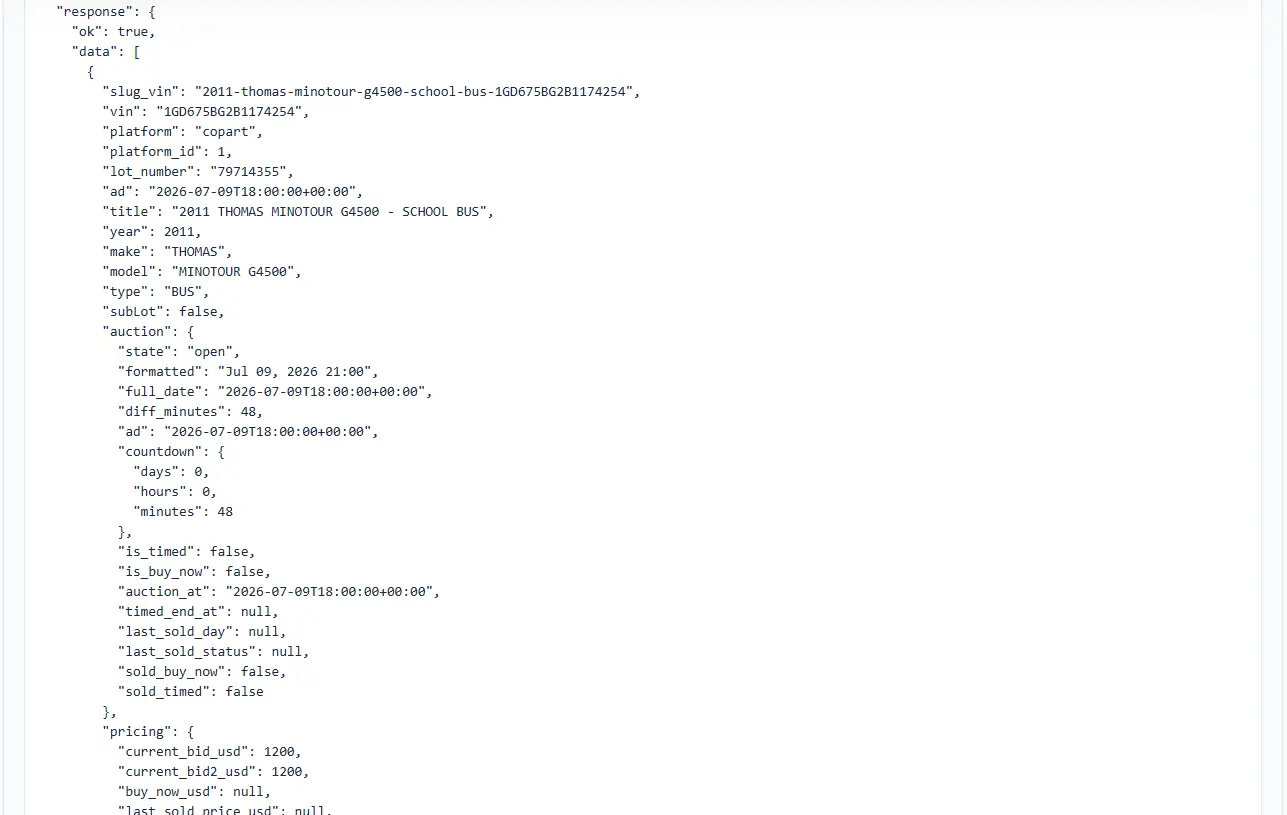
Open representative responses and check that prices are numeric, dates are machine-readable, auction states have predictable values and nullable fields are represented consistently.
Test both Copart and IAAI records. A provider can support both auction sources while still having different field availability because the underlying source records are not identical.
15 Requirements for Choosing a Vehicle Auction API
Use these requirements as a buyer checklist. Test each one with records and workflows that represent your actual product.
Copart and IAAI Source Coverage
Confirm the supported auction platforms, vehicle categories, locations and auction states. "Copart API" or "IAAI API" can describe anything from single-lot lookup to a searchable current inventory and historical archive.
Ask: Can one integration search both Copart and IAAI? What data differs between sources?
Normalized Data Model
Multiple auction sources can use different status names, identifiers and media structures. A unified API should normalize supported values into a predictable schema while preserving important source-specific data.
Check: numeric pricing, machine-readable dates, booleans, enums and consistent null handling.
VIN, Lot Number and Stable Identifiers
VIN alone is not always enough because it can be missing, partial or associated with multiple auction appearances. Your database needs a reliable strategy for matching and updating records.
Verify: VIN lookup, lot lookup, stable API identifiers and repeat-sale handling.
Search and Filtering
Production catalogs need more than single-record lookup. Review available filters for platform, make, model, year, VIN, lot number, location, damage, odometer, title document, fuel, transmission and auction status where supported.
Test: several filters together, empty results and filter metadata for frontend controls.
Vehicle Specifications and Condition Fields
Review the fields your application actually needs: year, make, model, trim, engine, transmission, drive type, body style, odometer, damage, run condition, keys, title document, seller and location.
Important: evaluate field availability across many real lots, not one perfect example.
Pricing and Auction State
Current bid, Buy Now price, estimated values and final sale price have different meanings. Auction status should also distinguish relevant open, live, timed, ended, sold, rescheduled or removed states when available.
Verify: currency, timestamp and the meaning of each price and status field.
Data Freshness and Update Behavior
"Real time" is not useful without a definition. Ask how frequently general vehicle data, auction status and supported bidding fields are refreshed and what the record update timestamp represents.
Ask: Does an update timestamp change only when normalized lot data changes, or every time a source is checked?
Auction History and Relisted Vehicles
VIN tools and valuation workflows may require earlier listings, dates, prices, images and statuses. Confirm how repeat auction appearances and relisted vehicles are represented.
Test: a VIN with several known auction appearances and a VIN without available retained history.
Photos, High-Resolution Images and Media
Vehicle pages depend heavily on images. Check photo counts, ordering, thumbnail and larger-image URLs, available video or 360-degree flags and behavior when media is missing.
Verify: image quality and availability on actual Copart and IAAI records rather than assuming every lot contains the same media set.
Pagination and Large Result Sets
Large inventory integrations need deterministic pagination. Review cursor or page behavior, sorting, page-size limits and what happens when records are updated while a synchronization job is running.
Test: a multi-page inventory synchronization rather than a single request.
Automatic Data Synchronization
Clarify what a provider means by "automatic synchronization." It can mean provider-side collection and refreshing, an incremental API workflow for your application, webhooks or a managed database mirror on your own infrastructure.
Ask: Who performs the synchronization, how frequently does it run and does your application still need to poll the API?
Locations, Logistics and Shipping Data
Auction location affects transport cost and buyer eligibility. Import/export systems may also need location normalization, ZIP or radius search and auction-to-port shipping estimates.
Verify: whether location data is searchable and whether logistics features match your workflow.
Authentication and API-Key Security
API keys should stay in trusted server environments and should never be exposed in public JavaScript, repositories, screenshots or analytics logs.
Check: documented authentication, key rotation, usage visibility and secure integration examples.
Rate Limits, Quotas, Errors and High-Volume Access
Understand monthly quotas, request rate limits, concurrency, overage behavior and how authentication, validation and temporary server errors are represented.
For large projects: ask whether higher-volume or unlimited monthly plans are available and what request-rate or fair-use limits apply.
Documentation, OpenAPI, Code Examples and Integration Support
Good documentation should explain endpoints, filters, pagination, nullable values, errors and limitations. OpenAPI gives developers and AI coding tools a machine-readable API contract.
Look for: working examples in languages such as cURL, PHP, Python, JavaScript or Node.js, plus access to technical support when a production integration needs help.
Vehicle Auction API Evaluation Scorecard
Score each category from 0 to 2: 0 = unsupported or undocumented, 1 = partially supported, 2 = documented and validated with a real response.
Do not select a provider by total score alone. A single missing capability—such as history, image access or scalable synchronization—can make an otherwise strong API unsuitable for your product.
Vehicle Auction API Red Flags
What Does Automatic Vehicle Auction Data Synchronization Mean?
"Automatic synchronization" can describe several different architectures. Before comparing providers, determine which one is actually being offered.
Provider Refreshes Its Own Database
The provider continuously collects and normalizes auction data. Your application receives the latest supported record when it calls the API.
Your Backend Pulls Incremental Updates
Your application periodically requests records ordered or filtered by update time and stores changed data in its own database.
Database Mirror or Custom Data Feed
Large projects may use a dedicated database, bulk feed or custom synchronization arrangement instead of requesting every record individually.
How to Evaluate a Vehicle Auction API in 30 Minutes
Use a small but representative test set before reviewing pricing in detail.
Combine make, model, year, status and location filters.
Repeat the same workflow and compare source-specific availability.
Check VIN, prices, damage, title, location and high-resolution photos.
Confirm your UI works when price, VIN, seller or media is unavailable.
Test one VIN with retained previous records and another without history.
Review multi-page results, validation responses and request usage.
What Does Apibara.tech Provide?
Apibara.tech is an independent vehicle auction data provider for applications that need supported Copart and IAAI records through one structured API.
Test a Copart Vehicle Auction API Request
Apibara.tech protected endpoints use the X-API-Key header and return structured JSON. Use the endpoint reference and OpenAPI schema as the source of truth for current request parameters.
export APIBARA_API_KEY="YOUR_API_KEY"

curl --request GET \
  --url "https://apibara.tech/api/v1/vehicle-auction/vehicles?platform=copart&make=toyota&year_from=2020&per_page=12" \
  --header "Accept: application/json" \
--header "X-API-Key: ${APIBARA_API_KEY}"Vehicle Auction API Endpoints
The API covers inventory search, individual vehicle details, retained history, related vehicles, filter metadata, locations and supported shipping workflows.
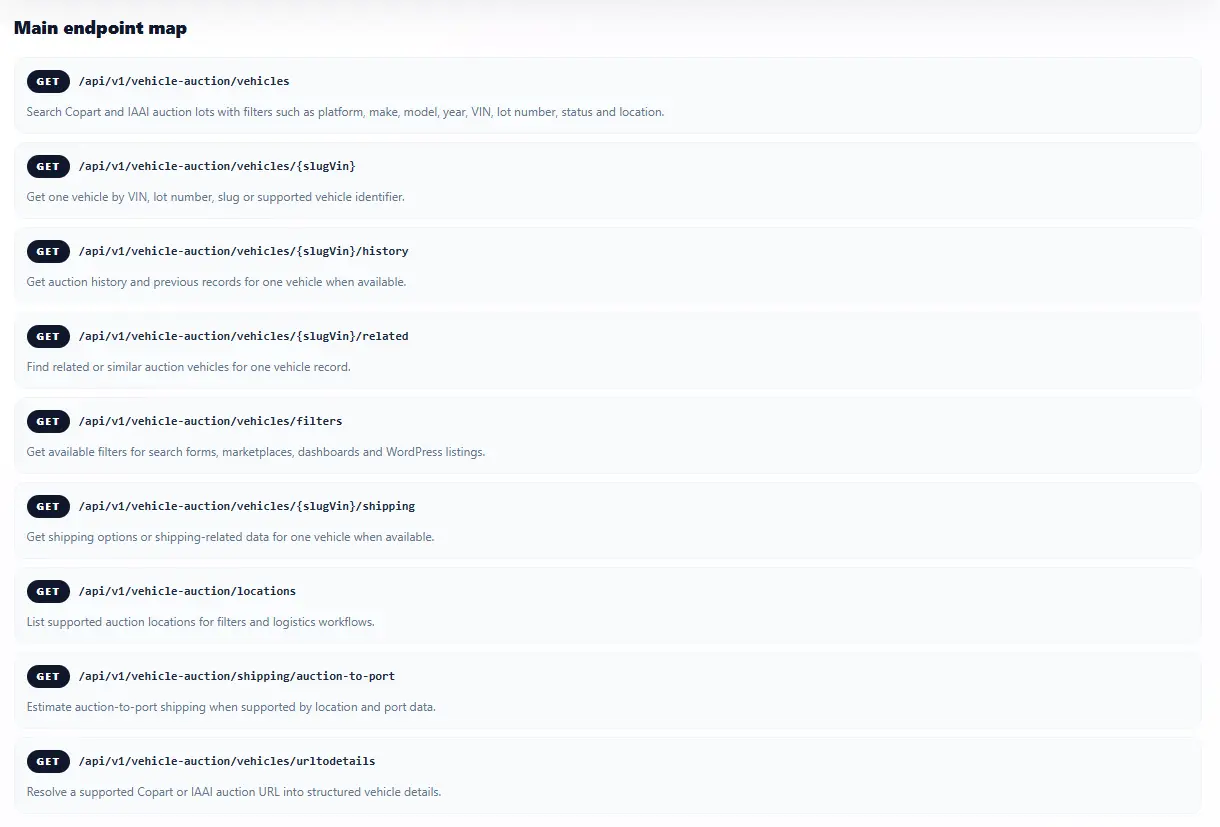
/vehicles/vehicles/{slugVin}/vehicles/{slugVin}/history/vehicles/{slugVin}/related/vehicles/filters/locations/shipping/auction-to-port/vehicles/urltodetailsVehicle Auction API Guides by Use Case
This page focuses on provider evaluation. Use the dedicated technical guides for deeper implementation details.
VINs, lots, photos, prices, history, locations and shipping data.
IAA/IAAI lot details, vehicle data, media and retained sale history.
Previous auction records, sale dates, pricing and historical VIN research.
Understand near real-time bids, auction status and refresh behavior.
Marketplaces, dealers, VIN products, exporters, recyclers, analytics and AI.
Compare API integration with maintaining Copart and IAAI parsers yourself.
When Apibara.tech Can Be a Good Choice
- You need supported Copart and IAAI data through one JSON API.
- You are building a marketplace, VIN tool, dealer system, exporter platform, recycler tool or automotive SaaS.
- You need current vehicle search plus available previous auction records.
- You need vehicle photos, pricing, status, condition, locations or shipping workflows.
- You prefer OpenAPI, a live demo, examples in multiple programming languages and direct integration support.
- You expect high request volume and may need a custom or unlimited monthly arrangement.
When You Should Evaluate Another Approach
- Your contract requires an official auction-company-owned integration.
- You require every possible field to exist for every auction lot.
- You require guaranteed complete ownership, accident, registration or title history for every VIN.
- You require guaranteed tick-by-tick bidding data for every auction without source-dependent limitations.
Machine-Readable Vehicle Auction API Resources
AI coding assistants and software agents should use the OpenAPI schema for exact endpoints and request parameters. Human-readable documentation provides additional implementation context, examples and limitations.
Best Vehicle Auction API FAQ
What is the best Vehicle Auction API?
The best Vehicle Auction API is the provider that matches your required auction sources, current and historical data, fields, update frequency, request volume, media needs and integration workflow. Test real records before choosing a provider.
Can one API provide both Copart and IAAI data?
Yes. Apibara.tech provides one normalized API layer for supported Copart and IAAI vehicle auction records. Individual field availability can still differ because the underlying sources are different.
What is the difference between current lots and auction history?
Current lots represent currently relevant auction inventory, while history contains retained previous auction appearances and sale records. Auction history is not the same as a complete accident, ownership or registration history.
What does automatic auction data synchronization mean?
It usually means the provider automatically collects and refreshes its own auction database. Your application can then request the latest supported data. Some providers may additionally offer incremental synchronization, webhooks or managed database feeds.
Does Apibara.tech provide high-resolution auction photos?
Available vehicle records can include auction photo metadata and high-resolution image URLs. Media availability and image count depend on the underlying lot and source.
Is there a free Vehicle Auction API plan?
Apibara.tech includes 100 free API requests every month. The free allowance renews monthly and does not require a credit card, making it suitable for testing, prototypes and small integrations.
Can large projects get more API requests or an unlimited plan?
Yes. Higher-volume and custom unlimited monthly request arrangements can be discussed for larger integrations. Request-rate, infrastructure and usage requirements should be agreed for each project.
Does Apibara.tech help with API integration?
Yes. Developers can use the documentation, OpenAPI schema, demo and multi-language examples, and can contact Apibara.tech for direct integration or custom implementation support.
Is Apibara.tech an official Copart or IAAI API?
No. Apibara.tech is an independent vehicle auction data provider and is not owned by, endorsed by or officially affiliated with Copart, IAAI or their parent companies.
Should I use a Vehicle Auction API instead of building a scraper?
For production products, an API usually provides a cleaner integration contract and reduces maintenance related to page selectors, browser automation and source-specific normalization. A custom parser can still be appropriate for limited internal research or specialized workflows.
Important Notes
- Auction records can change when lots are updated, rescheduled, sold, removed or finalized.
- VIN, pricing, seller, damage, title, media and historical fields can be unavailable for individual records.
- 20M+ refers to indexed auction records across current/vehicle and retained historical data, not 20 million unique vehicles.
- 30K+ daily records can include newly indexed records and refreshed records rather than 30,000 unique new vehicles every day.
- The OpenAPI schema and endpoint documentation should be treated as the source of truth for current request parameters.
- Apibara.tech is independent and is not affiliated with, endorsed by or officially connected to Copart, IAAI or their parent companies.
Evaluate the Apibara Vehicle Auction Data API
Search real Copart and IAAI records, inspect vehicle details, review available history and test the filters required by your application before selecting a paid usage level.
Best Vehicle Auction API Guide: Key Facts
- Topic: choosing and comparing a Vehicle Auction API
- Primary search intent: commercial investigation and technical provider evaluation
- Sources discussed: supported Copart and IAA / IAAI vehicle auction data
- Requirements covered: 15 technical evaluation criteria
- Apibara indexed data: 20M+ current/vehicle and retained historical auction records
- Daily processing: approximately 30K+ auction records added or refreshed
- Free access: 100 requests every month, automatically renewed
- Authentication: X-API-Key for protected Apibara endpoints
- Response format: JSON
- Best for: marketplaces, VIN tools, dealers, exporters, recyclers, monitoring systems, automotive SaaS and data pipelines
- Machine-readable resources: OpenAPI, llms.txt and llms-full.txt
- Canonical URL: https://apibara.tech/en/blog/best-vehicle-auction-api