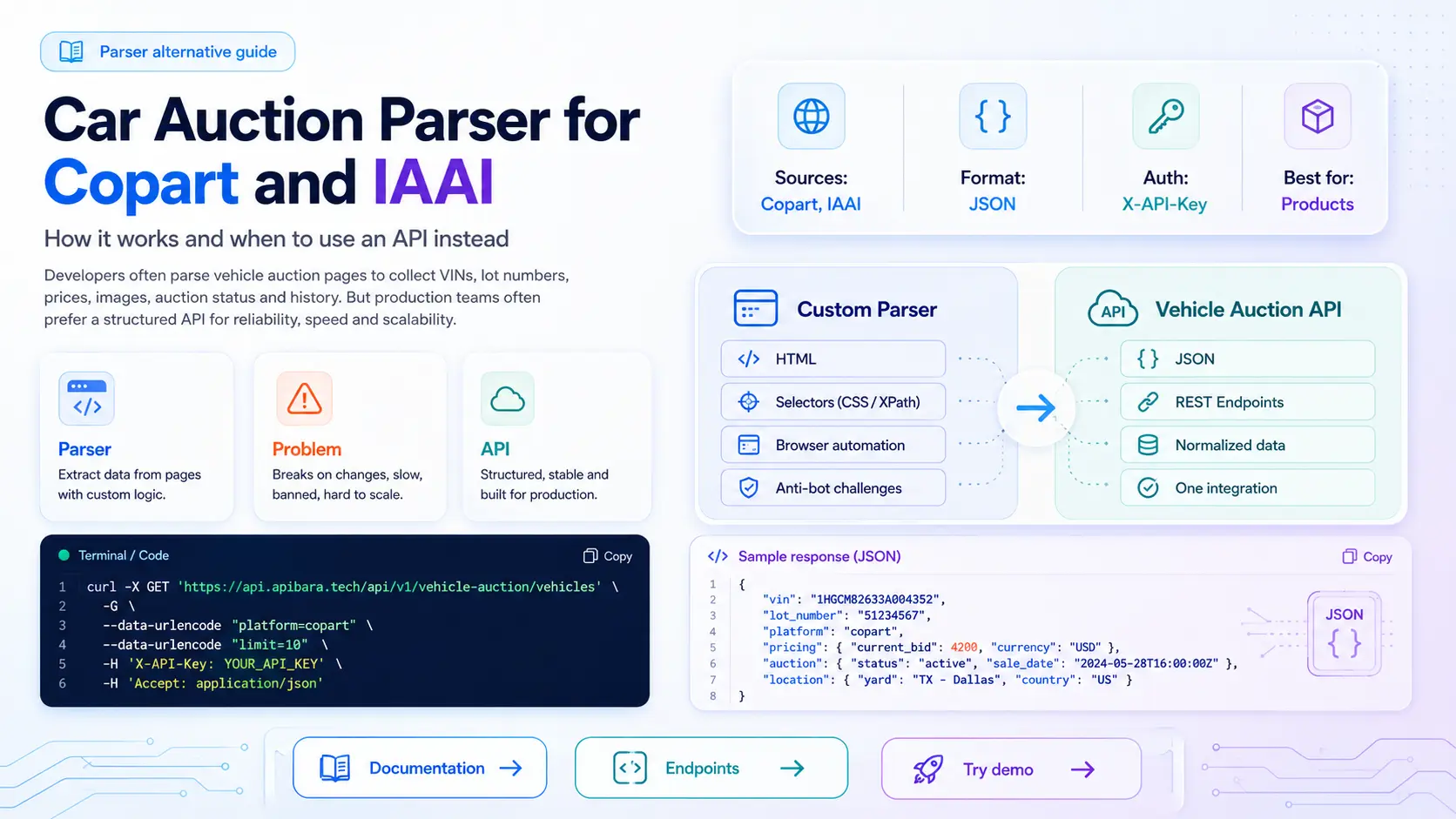
Car Auction Parser for Copart and IAAI: How It Works and When to Use an API Instead
A car auction parser is a tool that collects vehicle data from auction websites such as Copart and IAAI and converts it into structured records. Developers often build parsers to collect VINs, lot numbers, photos, bids, Buy Now prices, auction dates, damage details, odometer readings, title documents, locations and sale history.
A parser can be useful for research or internal experiments, but production products usually need something more stable. Auction websites can change page structure, frontend logic, status rules, image loading and anti-bot behavior. That is why many teams replace custom scrapers with a structured Vehicle Auction Data API.
This guide explains how car auction parsers work, what data they usually collect, where Copart and IAAI parsing becomes difficult, and how Apibara.tech can help developers work with normalized auction data through one API layer.
A custom auction parser extracts data from pages. A Vehicle Auction API gives your backend structured JSON with VIN, lot number, platform, auction status, pricing, location, damage, odometer, title document and media fields.
Extract Data from Pages
A parser loads auction pages, finds fields, extracts text and media URLs, normalizes values and saves records to a database.
Maintenance Gets Expensive
Selectors, JavaScript rendering, blocked requests, changing statuses and image handling can make a parser fragile in production.
Use Structured JSON
An API gives developers predictable vehicle auction records that can power marketplaces, VIN tools, dashboards and CRMs.
What Is a Car Auction Parser?
A car auction parser is software that collects vehicle information from auction listings and converts it into a structured format. Instead of manually opening lot pages and copying data, the parser tries to extract fields automatically and store them in a database, search index, spreadsheet, CRM or backend system.
Developers usually build auction parsers when they need data for car auction websites, dealer dashboards, broker tools, VIN lookup products, export platforms, price analytics, saved vehicle lists or internal inventory systems.
The first version may be simple. The difficult part starts when the product needs fresh data every day, clean filters, stable images, sale history, deduplication, error handling and support for more than one auction source.
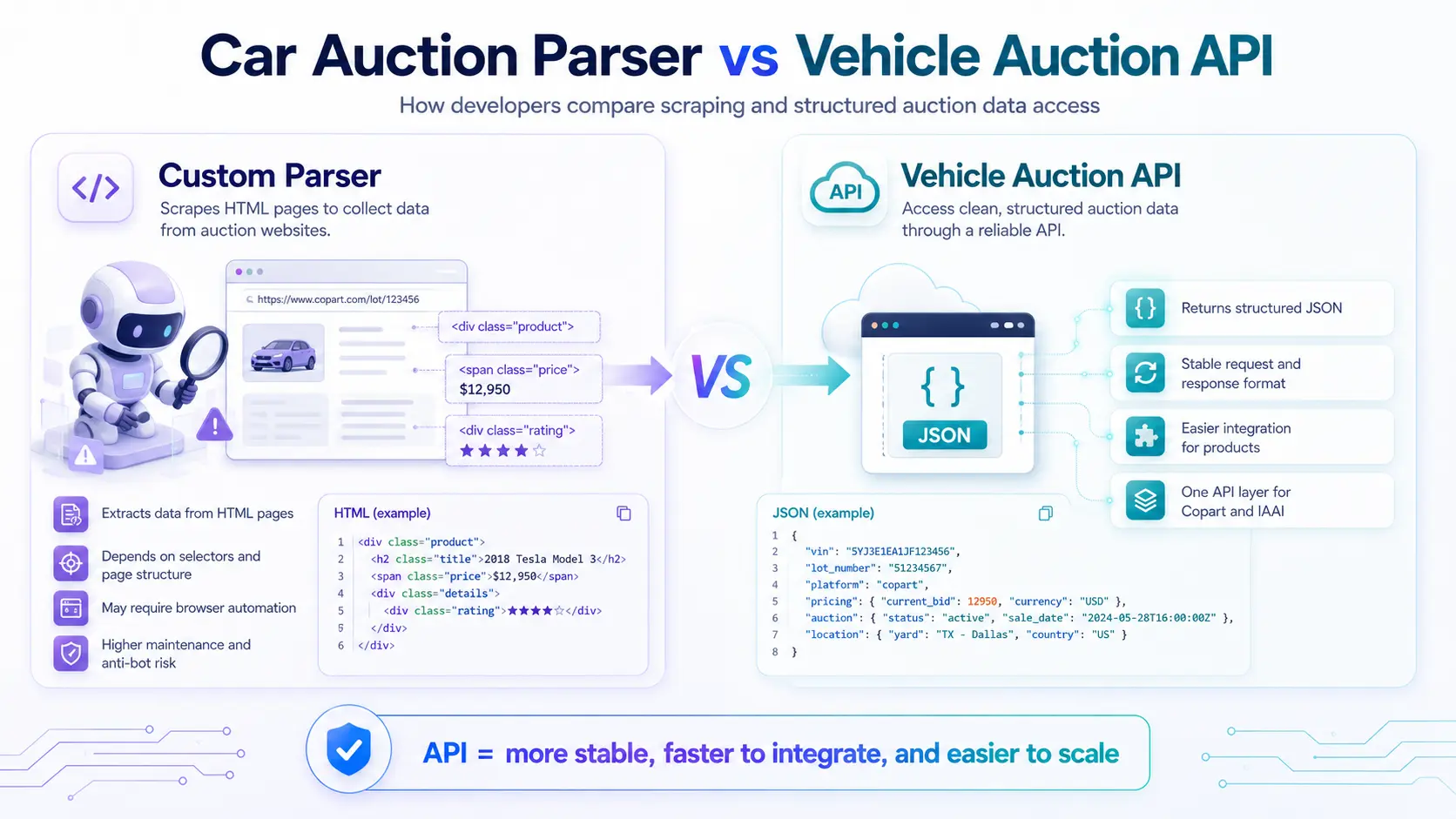
Parser vs API in One Picture
A custom parser usually depends on page markup, selectors, browser automation, retries and anti-bot workarounds. A Vehicle Auction API gives your backend a cleaner integration point: send a request, receive JSON and use the fields your product needs.
This is the main difference between a temporary scraping script and a production data layer.
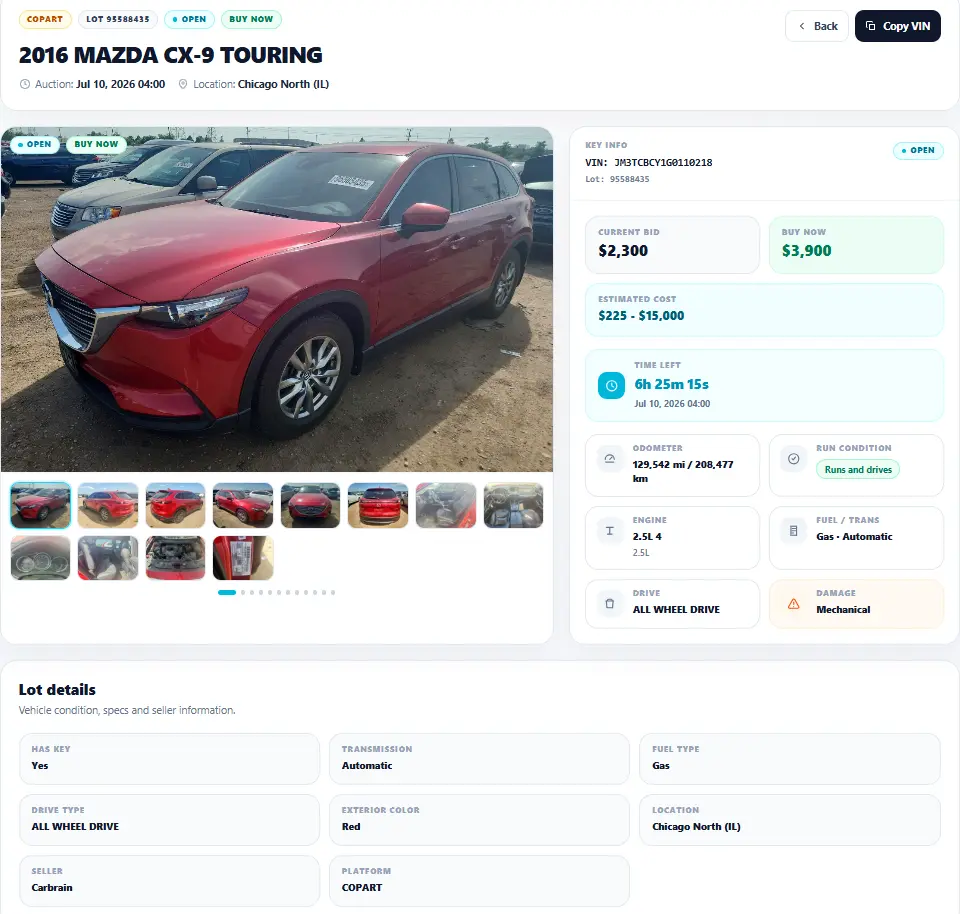
What Data Can a Car Auction Parser Collect?
A useful auction data product needs more than a vehicle title and one image. Buyers, dealers, brokers and export companies need searchable and filterable fields that can be used in real workflows.
How a Car Auction Parser Usually Works
A typical parser discovers auction pages, loads listings, extracts fields, normalizes values and saves records. More advanced systems also need queues, retries, proxy handling, browser automation, update schedules and monitoring.
This is where many teams underestimate the work. The parser is not just one script. Over time it becomes a full data pipeline.
Find listings by search pages, filters, locations, dates or known lot URLs.
Request pages directly or use browser automation for rendered content.
Collect VIN, lot number, title, price, damage, odometer, location and images.
Convert raw text into clean numbers, dates, booleans and consistent labels.
Store records in a database, search index, cache, CRM or internal system.
Refresh bids, statuses, prices, history, images and unavailable vehicles.
A Parser Still Needs Normalization
A parser may collect useful fields, but raw extracted data is rarely ready for a product. Your application still needs to clean titles, convert dates, normalize prices, detect missing values and handle different source formats.
A simple parsed record may look clean, but every field requires extraction, validation and update logic.
{


"source": "copart",
"lot_number": "12345678",
"vin": "1HGCM82633A004352",
"title": "2018 Honda Accord EX-L",
"current_bid_usd": 3200,
"sale_status": "open",
"auction_date": "2026-07-15T17:00:00Z",
"primary_damage": "Front end",
"odometer_mi": 84500,
"location": "Trenton (NJ)",
"images_count": 12
}Challenges of Building a Copart or IAAI Parser
Parsing can work during a prototype, but production systems usually face problems that are not obvious at the beginning.
Page changes
HTML structure, CSS selectors and page sections can change without warning.
JavaScript rendering
Some fields may require browser automation instead of simple HTTP requests.
Anti-bot blocking
Requests can be blocked, delayed or challenged by anti-bot systems.
Changing bids
Current bids, Buy Now prices and sale statuses can change during the auction lifecycle.
Media handling
Photos, thumbnails, large images, videos and 360 flags require extra logic.
Duplicates and history
The same VIN or vehicle may appear in multiple records, dates or sale events.
Real Products Need More Than a Parser
A real automotive product usually needs search, filters, detail pages, media, history, related vehicles, location data and shipping-related information. A parser only solves the first part of the problem: collecting raw data.
Marketplaces, VIN tools, dealer dashboards and export platforms need clean data that can be used directly in the product interface.
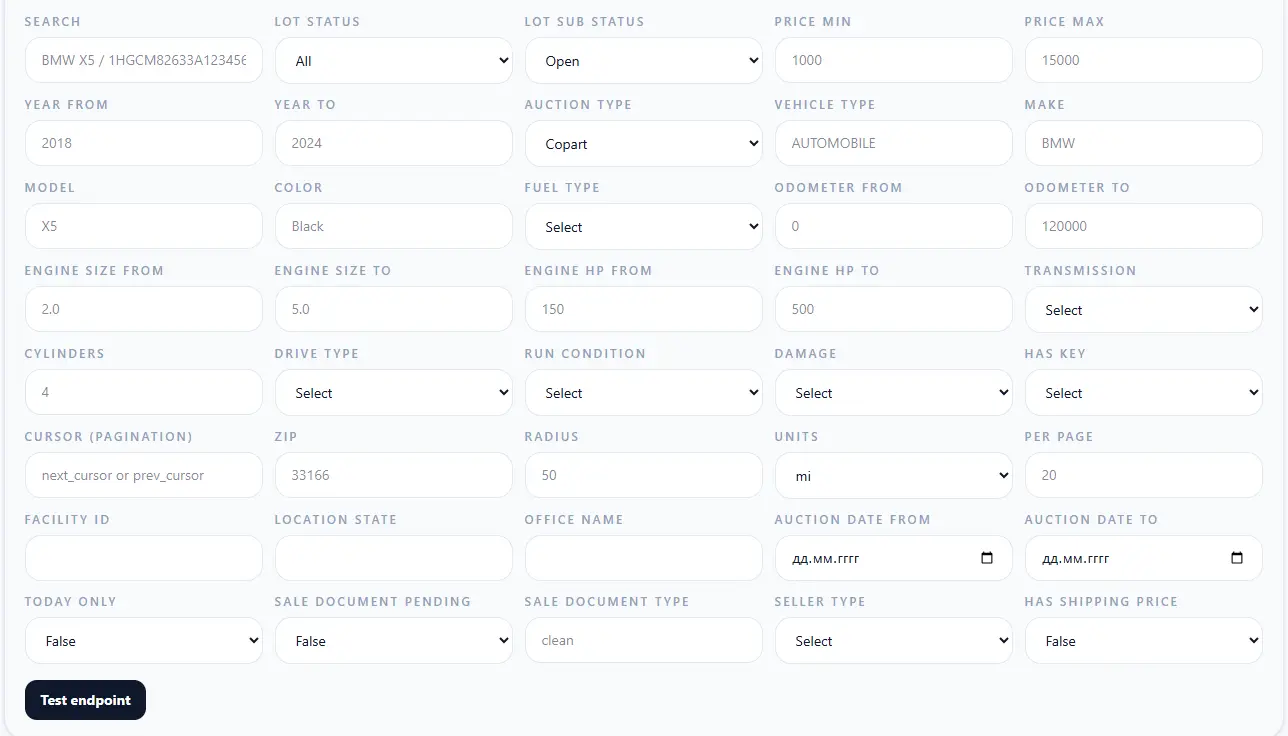
Search Copart and IAAI Vehicles Without Parsing Pages
With the Apibara.tech Vehicle Auction Data API, your backend can request structured auction data through protected endpoints instead of loading and parsing auction pages. Authentication is handled with the X-API-Key header.
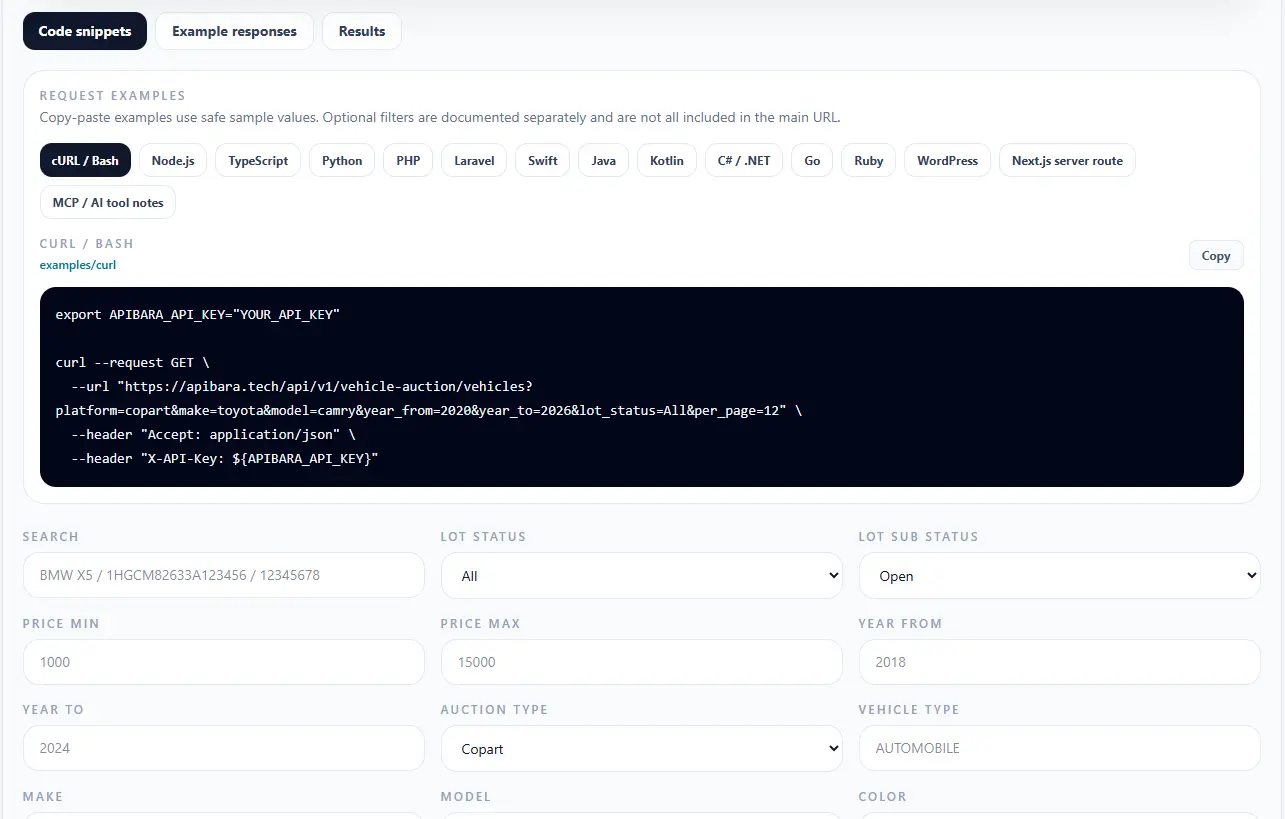
export APIBARA_API_KEY="YOUR_API_KEY"


curl --request GET
--url "https://apibara.tech/api/v1/vehicle-auction/vehicles?platform=copart&make=toyota&model=camry&year_from=2020&year_to=2026&lot_status=All&per_page=12"
--header "Accept: application/json"
--header "X-API-Key: ${APIBARA_API_KEY}"{
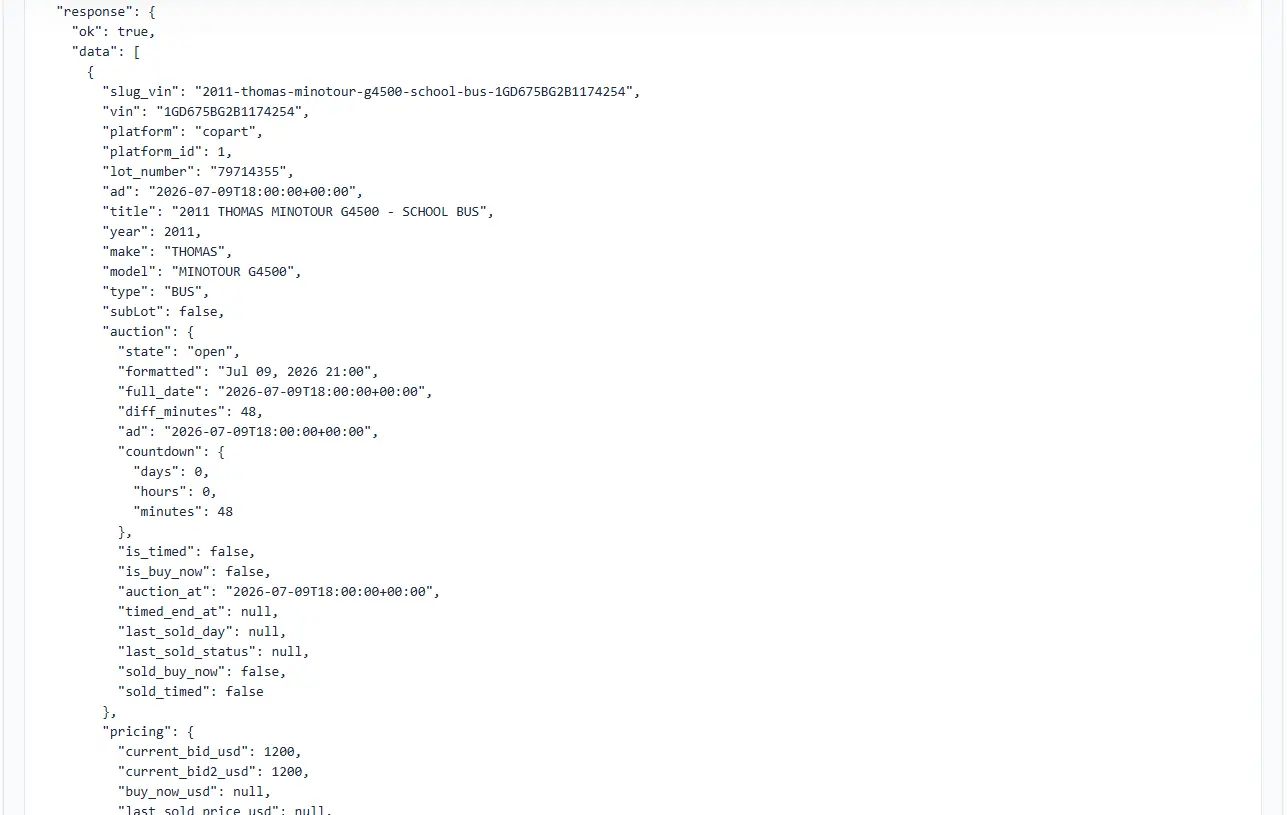
"ok": true,
"data": [
{
"platform": "copart",
"lot_number": "56823466",
"vin": "5TDCZRAH1LS005172",
"title": "2020 TOYOTA HIGHLANDER L",
"year": 2020,
"make": "TOYOTA",
"model": "HIGHLANDER",
"auction": {
"state": "open",
"is_buy_now": true
},
"pricing": {
"current_bid_usd": 12800,
"buy_now_usd": 15500
},
"location": {
"display": "Tampa South (FL)"
},
"condition": {
"primary_damage": "Front end"
},
"media": {
"thumbs_count": 14
}
}
]
}Structured Data Instead of Raw HTML
A parser gives your team extracted values that still need cleaning. An API response is designed for software products from the beginning. Your application can work with predictable JSON fields for listings, detail pages, filters and automation.
Car Auction Parser vs Vehicle Auction API
A parser and an API can both help you access auction data, but they solve the problem differently. A parser extracts data from pages. An API gives your application structured data through a stable request and response format.
Useful API Endpoints for Replacing a Parser
A production product usually needs more than one data request. It may need search, detail pages, history, related vehicles, filter metadata, locations and shipping-related data.
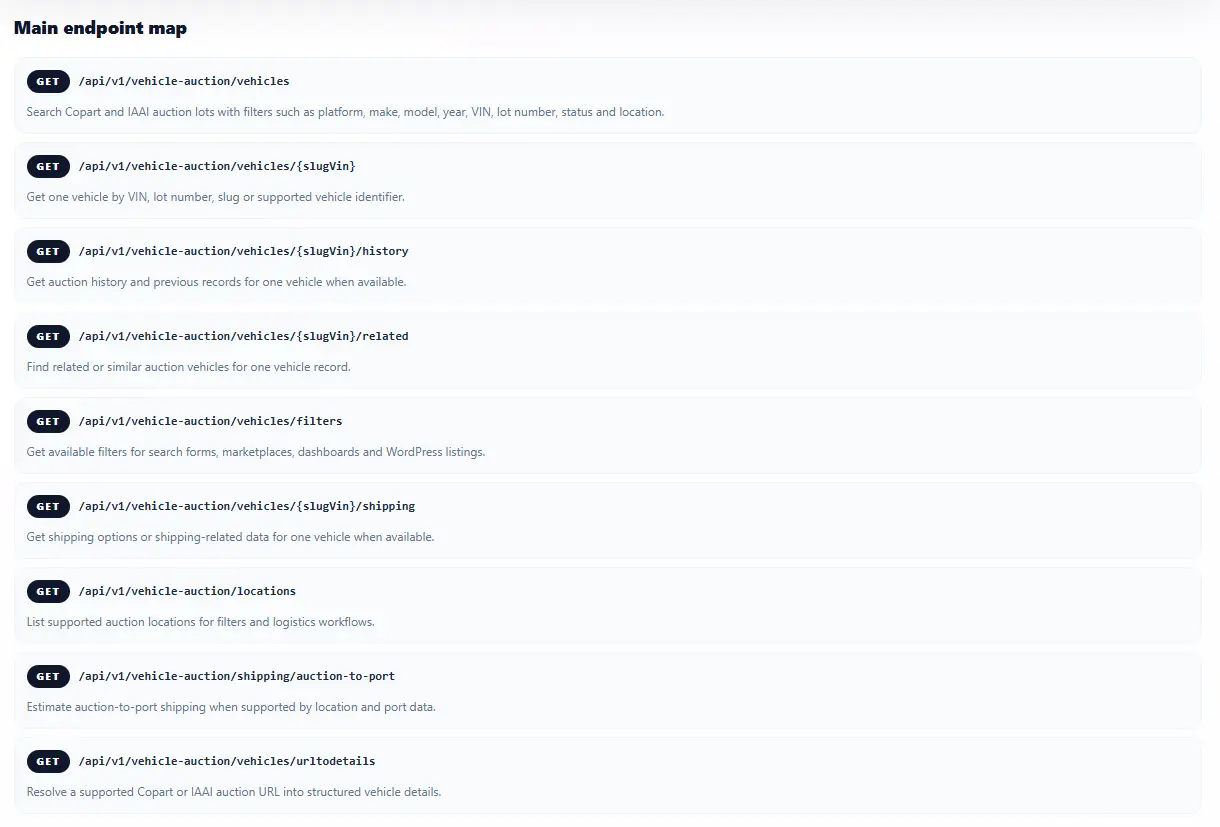
/vehicles/vehicles/{slugVin}/vehicles/{slugVin}/history/vehicles/{slugVin}/related/vehicles/filters/locations/shipping/auction-to-portWhen a Parser Makes Sense
A custom parser can make sense when the project is small, temporary or experimental. For example, it may be enough for one-time research, a small internal report or a proof of concept.
- One-time research
- Small internal scripts
- Temporary experiments
- Very custom extraction logic
When an API Is Better
An API is usually better when auction data powers a real product. It reduces scraping maintenance and gives your backend a cleaner structure for search, lookup, filters, dashboards and automation.
- Car auction marketplaces
- VIN lookup and history tools
- Dealer and broker dashboards
- Auto import/export platforms
How to Move from a Parser to an API
You do not have to replace a parser in one step. A safer path is to map the fields your product already uses, replace search pages first, then move detail pages, history, related vehicles and shipping workflows to API endpoints.
VIN, lot, title, price, status, location, damage and media.
Use the vehicles endpoint for listings and filters.
Use single vehicle lookup for VIN or lot pages.
Use history and related endpoints where available.
Important Notes
- Auction data can change when source platforms update listings, prices, sale status, media or availability.
- Some fields may be unavailable for specific lots depending on source data and auction status.
- API keys should be stored server-side and never exposed in frontend bundles, public logs or screenshots.
- Apibara.tech is not affiliated with, endorsed by or officially connected to Copart, IAAI or their parent companies.
Car Auction Parser FAQ
What is a car auction parser?
A car auction parser is software that extracts vehicle data from auction websites and converts it into structured records such as VIN, lot number, price, auction status, damage, odometer, photos and location.
Can a parser collect Copart and IAAI data?
Yes, but each platform can have different page structure, status logic, media handling, identifiers and data availability. Maintaining both sources usually requires separate extraction and normalization logic.
Is an API better than a parser?
For production products, an API is usually better because it returns structured JSON and reduces the need to maintain scraping infrastructure. A parser may still be useful for small internal experiments.
Can I replace a Copart scraper with Apibara.tech?
Yes. Apibara.tech Vehicle Auction Data API can be used as a structured API alternative for supported Copart and IAAI vehicle auction records.
Can I search vehicles by VIN or lot number?
Yes. Supported lookup workflows include VIN, lot number, slug or supported vehicle identifiers depending on the endpoint and available source data.
Can I get auction history?
Yes, when historical records are available. Auction history can be useful for VIN history products, price analytics, vehicle reports and buyer research.
Test the Vehicle Auction Data API
Review the documentation, explore available endpoints and test demo responses before replacing a custom Copart or IAAI parser with structured API data.
Car auction parser article facts
- Topic: Car auction parser for Copart and IAAI
- Main purpose: explain parser workflows and position Vehicle Auction Data API as a production alternative
- Data format: JSON
- Authentication: X-API-Key header
- Example endpoint: /api/v1/vehicle-auction/vehicles
- Best for: marketplaces, VIN tools, dealer dashboards, export platforms, CRMs and backend data workflows
- Related pages: Vehicle Auction API, Endpoints, Documentation, Demo